Artifact
The prompt persists
A prompt may be stored, copied, governed, compared, revised, and reused. Like a requirement, contract, or scientific hypothesis, it remains available to influence future interpretation and action.
A foundational AI-era application of CFT
Design communication matter so another intelligence can reconstruct not only the request, but the intended reasoning.
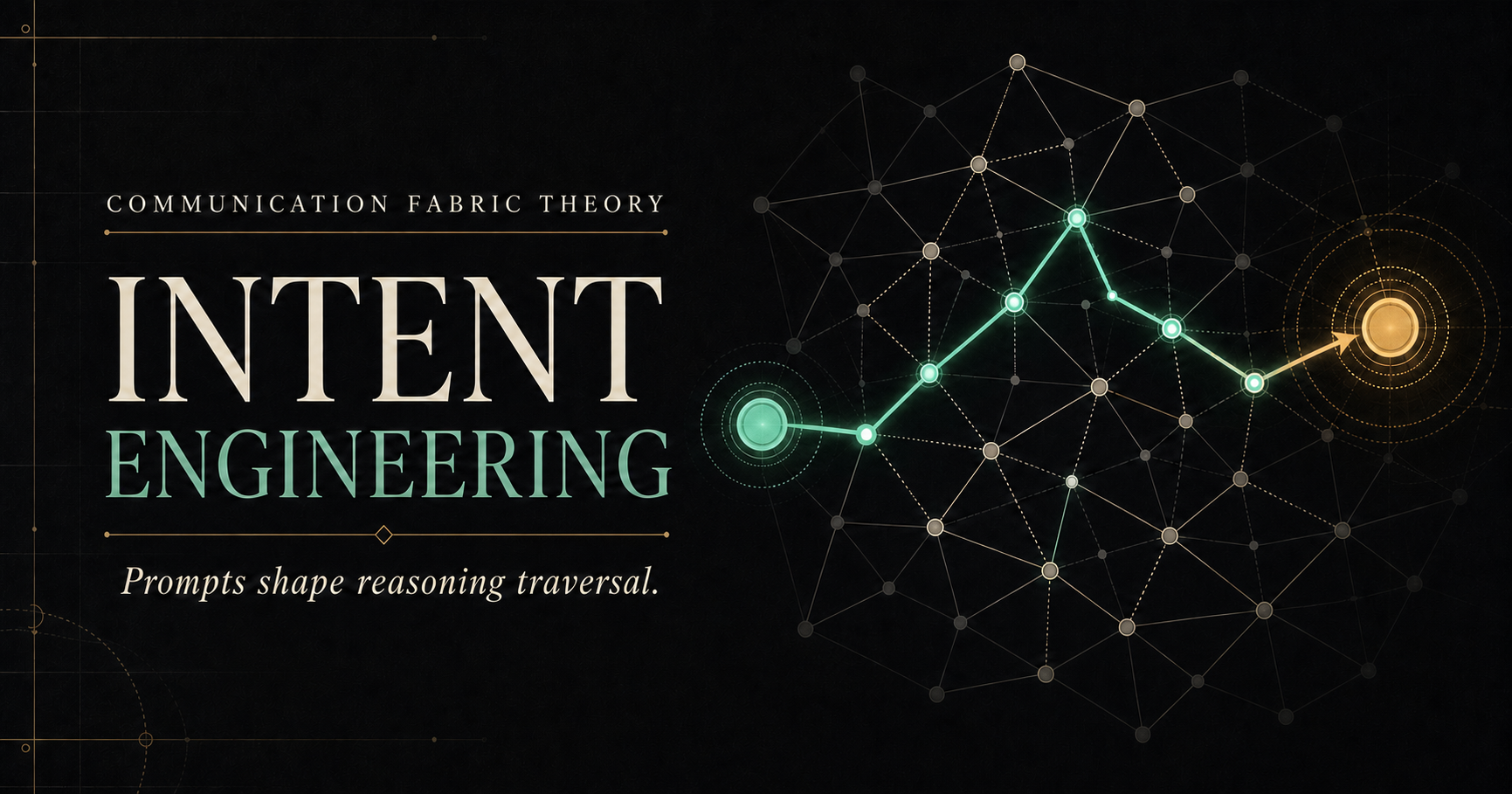
Prompts do not control reasoning. They shape its possible traversals.
Definition
Intent Engineering is the discipline of designing, refining, governing, and measuring communication artifacts that encode intent with sufficient fidelity for another intelligence—human or artificial—to reconstruct the intended reasoning process.
CFT interpretation
Within CFT, prompts are not merely instructions. They are persistent communication matter whose primary purpose is to encode intent.
Artifact
A prompt may be stored, copied, governed, compared, revised, and reused. Like a requirement, contract, or scientific hypothesis, it remains available to influence future interpretation and action.
Traversal
Reasoning does not execute a prompt directly. An intelligence constructs an internal representation within its Communication Association GraphThe connected internal structure through which communication matter is associated and made available for reasoning traversal. and reasons by traversing that graph.
Why prompting matters
These dimensions collectively define the intended reasoning traversal. A vague prompt permits many plausible paths. A precise prompt reduces ambiguity and increases the likelihood that the original intent will be satisfied.
Definition
Intent Fidelity is the degree to which communication matter accurately represents its creator's intended meaning.
It measures how faithfully intent survives communication. It is a property of the artifact itself, independent of any particular AI model.
ConsistencyMore stable reasoning across attempts
ReproducibilityClearer conditions for repeated work
Low ambiguityFewer equally plausible traversals
EvaluabilityExplicit grounds for assessing outcomes
AlignmentCloser correspondence between expected and actual results
The claim establishes an upper bound: reasoning quality cannot exceed the fidelity of the communicated intent. A capable reasoner may infer, explore, or ask for clarification, but no process can recover intent that the artifact neither encodes nor makes inferable.
Intent–reasoning lifecycle
Evaluation returns evidence to intent. The prompt therefore becomes versioned communication matter rather than disposable text.
Practical implementation
PromptCapsules are version-controlled intent artifacts: governed packages that preserve the prompt together with the information required to understand, reproduce, evaluate, and improve it.
Future concept: the PromptCapsule specification remains a proposed implementation pattern and requires independent technical definition.
Organizational implications
LLM prompts belong to the same architectural category as the artifacts organizations already use to encode expected meaning, action, limits, and accountability.
Prompts are encoded intent designed for artificial intelligences. This framing unifies human and AI collaboration under a common communication architecture while remaining applicable to software specifications, scientific hypotheses, contracts, and governance.
Relationship to CFT
Intent Engineering follows from the existing architecture. Intent initiates the creation of communication matter and gives its later traversal a purpose.